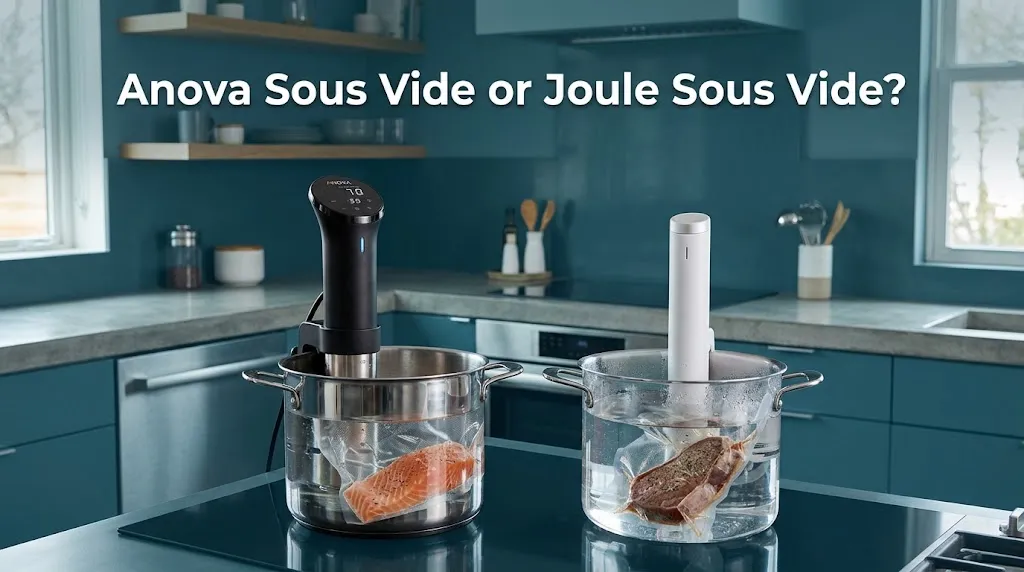
Anova Sous Vide or Joule Sous Vide? For steak cooking?

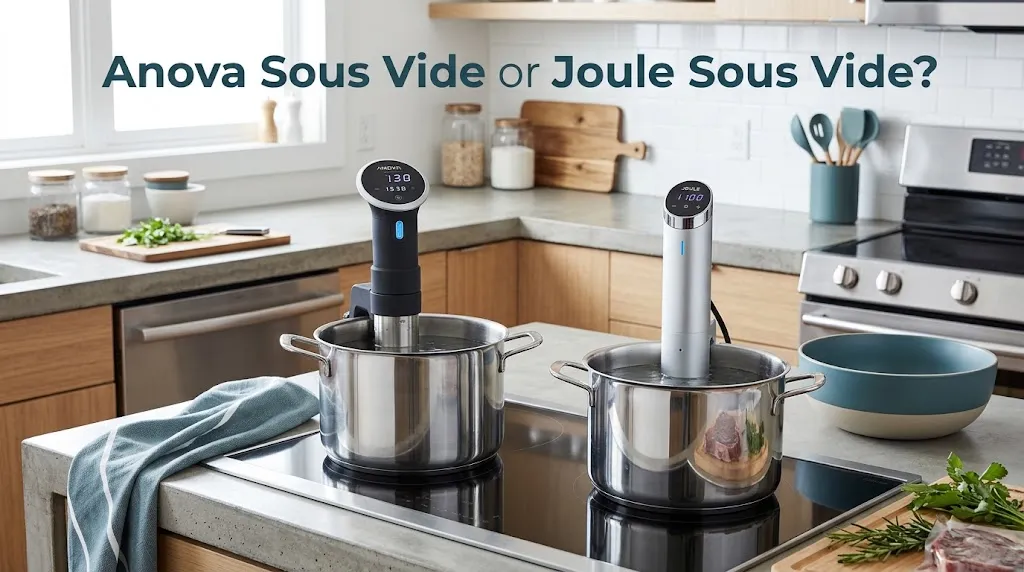
Choosing between Anova and Joule sous vide cookers for steak comes down to how you like to cook. Anova is a strong choice if you want hands-on control and a straightforward cooking setup, while Joule is appealing if you prefer a compact device and an app-guided cooking experience. Both can help you cook steak evenly, but the best option depends on your kitchen habits, budget, and preferred features.
Anova vs. Joule: Key Differences for Steak Cooking
The main difference is how you control each cooker. The Anova Precision Cooker 3.0 provides controls on the device itself, while the Breville Joule Turbo relies on its companion app. Both models list 1,100 watts of heating power, so the better choice is not simply a matter of wattage.
| Feature | Anova Precision Cooker 3.0 | Breville Joule Turbo |
|---|---|---|
| Best for | Hands-on control and flexibility | Guided, app-based cooking |
| Heating power | 1,100 watts | 1,100 watts |
| On-device controls | Yes, with a display | No; app required |
| App experience | Remote control and monitoring | Guided recipes, Turbo mode, and visual doneness guidance |
| Design | Immersion circulator with adjustable clamp | Compact circulator with a magnetic foot |
| Cooking guidance | Set your own temperature and time | Guided cooking through the Breville+ app |
| Main trade-off | Larger device to store | More dependence on your phone |
| Available |  | |
These differences matter most when you cook steak regularly. Neither machine automatically guarantees a better sear or more flavorful beef. Steak thickness, temperature selection, cooking time, and the final sear also affect the result.
Which Sous Vide Cooker Makes Better Steak?
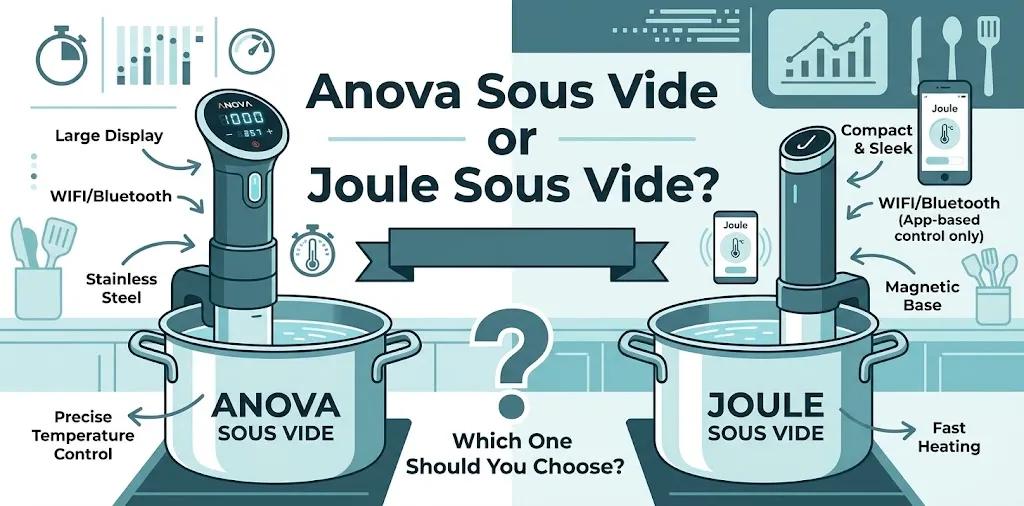
Anova is the better all-around choice for steak cooks who want direct control, while Joule Turbo is a strong option for cooks who prefer guided recipes and a compact design. Both can maintain a controlled water bath for evenly cooked steak. If you use the same temperature, suitable cooking time, and searing method, either can produce excellent results.
Choose Anova for hands-on control
Anova makes sense if you prefer to set the cooking temperature directly on the device. You can start a steak cook without depending on your phone to enter the basic settings.
This is useful when you cook from a trusted recipe, repeat the same steak preparation every weekend, or want a simple way to adjust the temperature while working in the kitchen.
The Precision Cooker 3.0 also offers Wi-Fi connectivity and app-based monitoring, so direct controls do not mean you have to give up connected features.
Choose Joule for guided cooking
Joule Turbo is designed around an app-led cooking experience. Its Breville+ ecosystem includes guided recipes, visual doneness selection, and Turbo technology for certain supported recipes. Breville says the Turbo feature can reduce cooking time by as much as half for selected dishes compared with conventional sous vide methods. That claim should not be treated as a guarantee for every steak or thickness.
Joule is especially appealing if you are new to sous vide and want instructions that help you choose a result instead of setting every detail yourself.
The trade-off is straightforward: if your phone is unavailable or you do not want to use an app, Joule’s app-dependent controls can be inconvenient.
How to Cook Steak With Either Machine
The cooking process is nearly identical with both devices. Your main decisions are the desired doneness, steak thickness, and how much time you have.
1. Choose your target temperature
Use the table below as a practical starting point for the steak’s final sous vide doneness. Temperature preference is personal, and the time needed depends on the cut and thickness.
| Desired doneness | Approximate water-bath temperature |
|---|---|
| Rare | 120–129°F |
| Medium-rare | 129–135°F |
| Medium | 135–145°F |
| Medium-well | 145–155°F |
| Well-done | 155°F and above |
These ranges are cooking preferences, not a guarantee of food safety. Lower-temperature sous vide cooking requires suitable time and temperature controls to reduce food-safety risks. For conservative food-safety guidance, follow USDA recommendations rather than relying on doneness alone.
2. Season and seal the steak
Season your steak with salt and pepper. Place it in a suitable food-safe sous vide bag, remove excess air, and seal it according to the bag’s instructions.
Keep the steak in a single layer when possible. If cooking more than one steak, avoid tightly stacking the bags because water needs to circulate around them.
3. Set the cooker and cook
Attach your chosen circulator to a suitable pot or container, fill it with water to the manufacturer’s required level, and set the temperature.
Follow a reliable time-and-temperature recipe that accounts for steak thickness and food safety. A thin strip steak and a thick ribeye should not automatically receive the same cooking time.
Anova lets you set the basic cooking parameters on the device. With Joule, use the Breville+ app to select and start a supported cooking method.
4. Dry and sear the steak
When the steak finishes cooking, remove it from the bag and pat the surface thoroughly dry. Sear it in a very hot skillet with a small amount of suitable high-heat cooking oil, turning as needed to develop a brown crust.
Sous vide controls the interior doneness; the skillet creates the crust. A wet steak will steam instead of browning efficiently, so drying the surface is an important step.
Price and Value: Is Joule Worth the Extra Cost?
Price can affect the decision, especially if you are buying your first sous vide cooker. The value comes down to which features you will actually use.
- Anova offers better practical value if you want to operate the cooker directly, follow your own recipes, and use the app when convenient.
- Joule may justify its premium if you value guided recipes, visual doneness selection, and Turbo cooking for supported dishes.
- Neither requires you to buy a premium steak to get value from sous vide. A reasonably priced cut can benefit from controlled cooking, especially when you want repeatable doneness.
For example, if you cook ribeye every Saturday using the same temperature and timing, Anova’s direct controls may be all you need. If you often try different cuts and prefer step-by-step instructions, Joule’s guided cooking features may be more useful.
Common Mistakes That Affect Sous Vide Steak
Even a good immersion circulator cannot fix every cooking mistake. Pay attention to these details regardless of which model you choose.
- Choosing a temperature without considering food safety: A low cooking temperature does not automatically make steak safe. Use a trusted time-and-temperature guide appropriate for the cut and thickness.
- Ignoring steak thickness: Thick steaks generally need more time for heat to reach the center than thin steaks.
- Skipping the final sear: Sous vide creates an evenly cooked interior, but it does not produce the browned crust many steak lovers want.
- Overcrowding the water bath: Leave enough space for water to circulate around the bags.
- Assuming Turbo works for every recipe: Joule’s faster cooking feature is intended for supported dishes, not every possible steak preparation.
- Buying based on wattage alone: Both featured models list 1,100 watts. Controls, app dependence, container fit, and ease of use may matter more to your decision.
Frequently Asked Questions
Here are answers to common questions about choosing between Anova and Joule for steak cooking.
Is Anova or Joule better for a beginner cooking steak?
Anova is a good choice if you want direct controls and the freedom to follow recipes from different sources. Joule Turbo is attractive if you prefer guided recipes and app-based doneness selection. Both can work for beginners who follow reliable cooking instructions.
Can Anova and Joule cook steak to the same doneness?
Yes. Both can maintain a controlled water-bath temperature, allowing you to target rare, medium-rare, or medium steak. The final result depends on the selected temperature, cooking time, steak thickness, and searing technique—not just the brand of cooker.
Is Joule Turbo faster than Anova for steak?
Joule Turbo offers a special faster-cooking mode for selected recipes, but that does not mean it will cook every steak faster than Anova. Both models list 1,100 watts, so compare the specific recipe, steak thickness, and total preparation time before choosing based on speed.
Final Verdict
For most home cooks who want straightforward controls and flexibility, Anova Precision Cooker 3.0 is my recommended choice. Its built-in display lets you control a steak cook without relying on a phone, while its connected features provide extra convenience when needed.
Choose Joule Turbo instead if you prefer guided cooking, a compact design, and supported Turbo recipes. Its app-based approach may be a better fit for someone who likes following instructions rather than adjusting every setting manually.