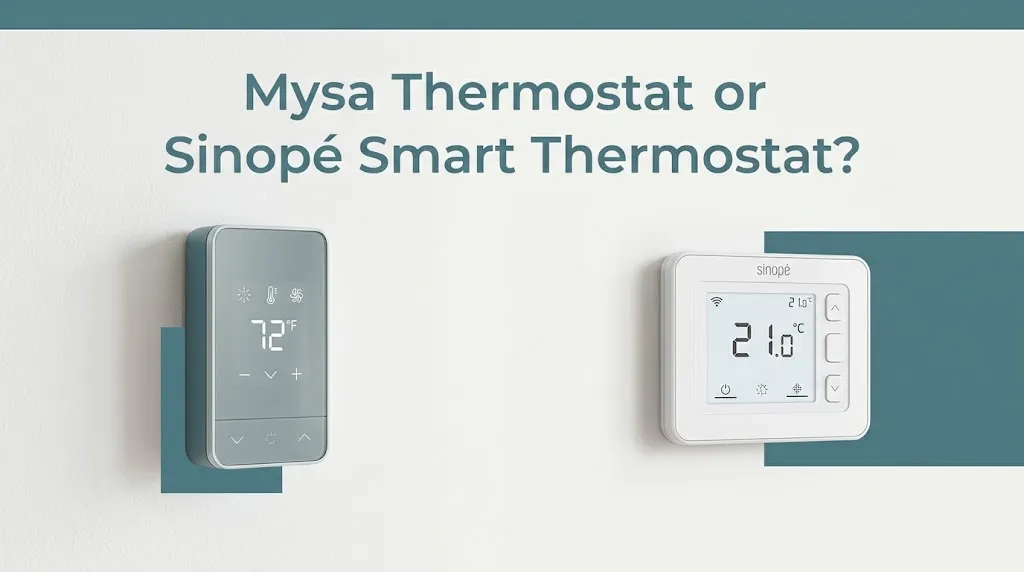
Mysa Thermostat or Sinopé Smart Thermostat? For baseboard heat?

Choosing between a Mysa thermostat and a Sinopé smart thermostat for electric baseboard heat comes down to compatibility, smart-home features, temperature control, and price. Both brands offer smart thermostats for electric heating, but the right choice depends on your heater’s voltage, electrical load, wiring, preferred app, and whether you want basic remote control or more advanced home automation.
Mysa vs. Sinopé at a Glance
Both brands offer smart thermostats designed for electric baseboard heating, but they differ in wiring flexibility, energy monitoring, and control options. Mysa offers different models for different budgets, while Sinopé provides Wi-Fi and Zigbee options with varying installation requirements and electrical ratings.
| Feature | Mysa for Baseboards | Sinopé Smart Thermostat |
|---|---|---|
| Best for | Smart scheduling and easy app control | Wiring flexibility and energy management |
| Heating systems | Compatible electric baseboards and other line-voltage heaters | Compatible electric baseboards and other electric heaters |
| Voltage | 120V, 208V, or 240V | 120V, 208V, or 240V, depending on model |
| Wiring | Specific models generally require four wires, excluding ground | Selected models support two-wire or four-wire installations |
| Maximum load | V2 and Lite: 3,800W at 240V | Model-dependent; selected versions support 3,000W or 4,000W at 240V |
| App control | Yes | Yes |
| Scheduling and geofencing | Yes | Yes |
| Energy monitoring | Detailed energy charts on V2; more limited on Lite | Consumption reporting on compatible models |
| Smart-home integration | Apple HomeKit, Google Home, and Alexa on compatible models | Integrations vary by model |
| Network | 2.4 GHz Wi-Fi | Wi-Fi or Zigbee, depending on model |
| Availble |  | |
Specifications vary by model, so confirm the exact version before purchasing.
What Makes Mysa a Good Choice for Baseboard Heat?
Mysa focuses on giving homeowners convenient control over electric heating through a smartphone app. It can be a good fit if you want to set a weekly schedule, change the temperature while away, or connect your heating to an existing smart-home setup.
Scheduling and remote control
The Mysa app lets you create temperature schedules around your routine. For example, you can set a lower temperature during the workday and a more comfortable setting before you return home.
You can also adjust the thermostat remotely rather than walking to the wall unit every time you want a change. Scheduling and geofencing can reduce unnecessary heating, although actual savings depend on your home’s insulation, outdoor temperatures, and heating habits.
Mysa V2 or Mysa Lite?
Mysa offers two main baseboard thermostat options: V2 and Lite.
- Mysa V2: Better for people who want energy-use charts, humidity monitoring, grouped thermostat zones, saved schedules, and temperature alerts.
- Mysa Lite: Better for buyers who mainly want remote temperature control, scheduling, and geofencing at a lower purchase price.
The listed US prices have been approximately $159 for V2 and $99 for Lite, although promotions and availability can change. Check current pricing before buying.
What are Mysa’s limitations?
The main concern is installation compatibility. Mysa V2 and Lite generally require an existing wall thermostat, compatible line-voltage wiring, and four wires in the electrical box, excluding the ground wire.
They also have a maximum load of 3,800 watts at 240 volts. If your heating circuit exceeds the model’s rating, you cannot solve the problem simply by changing an app setting or thermostat schedule.
Mysa also requires a 2.4 GHz Wi-Fi network for connected features.
What Makes Sinopé a Good Choice for Baseboard Heat?
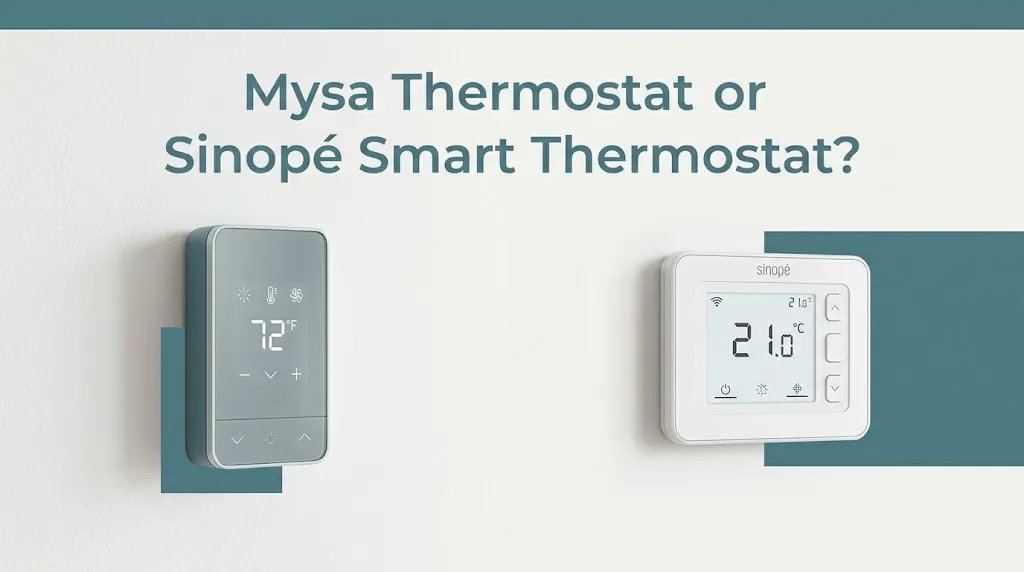
Sinopé is worth considering if your existing wiring, energy-management needs, or smart-home setup make it a better match than Mysa.
More wiring options on selected models
Some Sinopé Wi-Fi models support both two-wire and four-wire installations. That can make them an option for older homes where the wiring does not meet Mysa V2 or Lite requirements.
However, two-wire compatibility does not mean every Sinopé thermostat will work with every two-wire system. The exact model, voltage, heater type, minimum load, and wiring arrangement still matter.
Energy management and electricity costs
Sinopé offers consumption reports through its Neviweb platform on compatible models. Some thermostats also support its Éco Sinopé energy-management feature, which can adjust heating around certain electricity pricing or demand-response programs.
This can be useful if your electricity provider offers a compatible program. Availability and financial benefits depend on your location, utility provider, thermostat model, and applicable program rules.
Wi-Fi or Zigbee?
Sinopé offers different connectivity options for different needs.
- Wi-Fi: A practical choice for individual rooms or a typical home. Compatible models connect directly to your wireless network.
- Zigbee: Worth considering for a larger smart-home system built around compatible devices and a suitable gateway.
Do not assume that every Sinopé model has the same smart-home integrations or works with the same hub. Check the manufacturer’s compatibility information before buying.
What are Sinopé’s limitations?
Sinopé’s product lineup can be confusing because similar-looking thermostats have different wiring requirements, load limits, and supported heating types.
For example, some models support fan-forced convectors, while other versions have different restrictions. Some Zigbee options require a compatible gateway, and certain energy-monitoring features require additional setup.
Check the exact model number rather than choosing by appearance or brand alone.
Which Thermostat Is Better for Your Home?
The best choice depends on the electrical setup and the features you will actually use.
Choose Mysa if you want detailed app features
Mysa V2 is a strong option if your wiring is compatible and you want energy charts, humidity monitoring, scheduling, and smart-home control in one system.
For example, imagine a homeowner with a 240V bedroom baseboard heater who wants to monitor heating use and set different weekday and weekend temperatures. Mysa V2 is a sensible option if the heater’s load and wiring meet its requirements.
If those extra features are unnecessary, Mysa Lite may offer better value.
Choose Sinopé if your wiring or energy program favors it
Sinopé may be the better fit if your electrical box has a compatible two-wire arrangement or if you want to build a larger smart-home system around its Zigbee devices.
For example, a homeowner replacing an older thermostat might discover that the existing box does not meet Mysa’s wiring requirements. A compatible Sinopé model could be a more practical option, provided its voltage and load ratings also match.
If you participate in a supported electricity demand-response program, Sinopé’s energy-management features may be another reason to choose it.
Check These Details Before Buying
Smart thermostats for electric baseboard heating are not interchangeable with standard thermostats designed for central HVAC systems.
Before choosing either brand, verify these points:
- Heater voltage: Confirm whether the circuit uses 120V, 208V, or 240V.
- Total wattage: Add the wattage of every heater controlled by that thermostat.
- Wire configuration: Check the existing thermostat’s wiring against the manufacturer’s requirements.
- Heater type: Confirm compatibility with baseboards, convectors, fan-forced heaters, or radiant heating, as applicable.
- Minimum and maximum load: Ensure the circuit falls within the selected model’s permitted range.
- Smart-home requirements: Verify support for your preferred platform and whether a hub is needed.
- Installation rules: Follow local electrical codes and use a licensed electrician where required.
For reference, Mysa V2 and Lite are rated for up to 1,900W at 120V or 3,800W at 240V. Some Sinopé models support up to 3,000W or 4,000W at 240V, depending on the version.
Because these thermostats control line-voltage electricity, do not rely on wire color alone to identify connections. If you are unsure about the circuit or installation, ask a qualified electrician to check it.
Does Either Thermostat Actually Save Money?
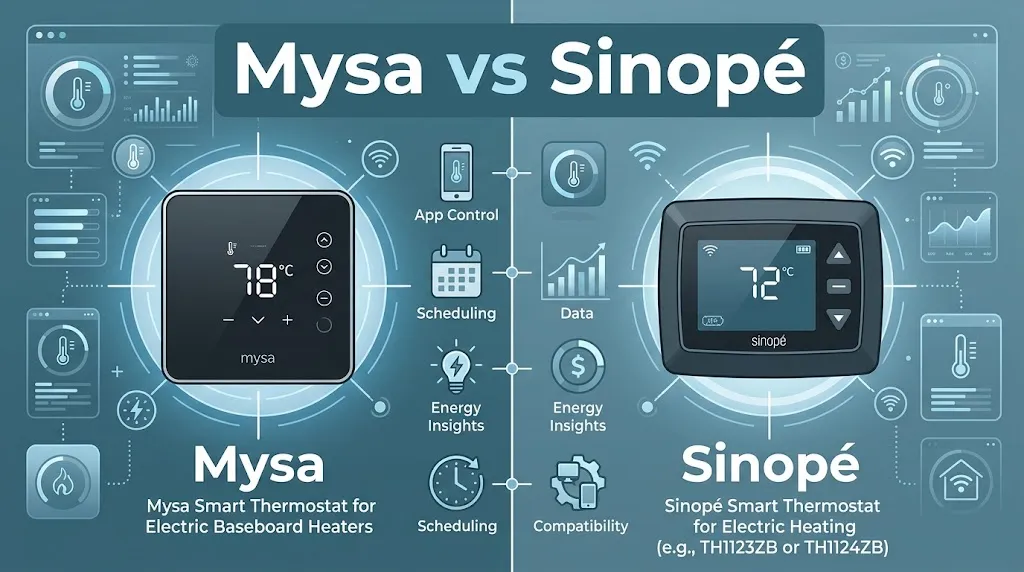
Both thermostats can help reduce wasted heating by lowering temperatures when a room is empty or when less heat is needed. However, neither guarantees a specific reduction in your electricity bill.
Your results depend on how you use your baseboard heaters, your local electricity rates, insulation, room size, and outdoor temperature. Energy reports can help you understand usage, but they do not automatically mean you will spend less.
The most useful approach is to create a realistic schedule and avoid heating rooms to higher temperatures than you need. If your utility offers an eligible rebate or demand-response program, check the conditions before counting that benefit toward the purchase price.
Frequently Asked Questions
Here are three practical questions to consider before choosing a smart thermostat for your electric baseboard heating system.
Is Mysa or Sinopé better for 240V baseboard heaters?
Both brands offer thermostats for compatible 240V electric baseboard systems. Mysa V2 and Lite support up to 3,800W at 240V, while certain Sinopé models support up to 3,000W or 4,000W. Choose based on your total heater load, wiring, and required features.
Can I install Mysa or Sinopé without a neutral wire?
It depends on the exact thermostat model and wiring arrangement. Mysa V2 and Lite have specific wiring requirements, while some Sinopé models support two-wire installations. Have the existing wiring checked against the manufacturer’s installation guide before ordering a replacement.
Will either thermostat work with Apple Home?
Mysa V2 and Lite support Apple HomeKit. Compatible Sinopé Wi-Fi models also support Apple Home, but you should verify the exact model and any setup requirements before buying.
Final Verdict
Mysa is a great choice for homeowners who want easy app control, smart scheduling, and convenient energy monitoring. Sinopé is worth considering if you need more wiring flexibility, a higher electrical load rating on a compatible model, or specialized energy-management features.
Winner: Mysa for overall convenience; Sinopé for wiring flexibility and specific energy-management needs.
Before buying, check your baseboard heater’s voltage, total wattage, and existing wiring. The best thermostat is the one that fits your heating system and the smart features you will actually use.