Amazon Smart Thermostat or Nest E? For budget energy saving?

Choosing between the Amazon Smart Thermostat and the Nest Thermostat E comes down to your budget, smart home setup, and heating and cooling habits. The Amazon model is a practical choice for Alexa users who want affordable smart temperature control, while the Nest Thermostat E may appeal to buyers who value its learning features and established thermostat design. Both can help manage energy use, but neither guarantees lower bills.
Amazon Smart Thermostat vs. Nest Thermostat E: At a Glance
| Feature | Amazon Smart Thermostat | Google Nest Thermostat E |
|---|---|---|
| Best for | Budget-conscious Alexa users | Buyers who prefer Nest’s learning features |
| Temperature scheduling | Yes | Yes |
| Automatic adjustments | Alexa routines and supported automatic controls | Auto-Schedule and Eco Temperatures |
| Phone control | Alexa app | Nest app |
| Voice control | Alexa | Google Assistant and compatible smart home setups |
| Energy-saving tools | Scheduling, away settings, and energy incentives where available | Adaptive scheduling and Eco settings |
| C-wire | Required, or a compatible adapter | Depends on the HVAC system |
| New-purchase availability | Available through retail channels | Limited availability; generally not sold directly by Google |
| Available |  | |
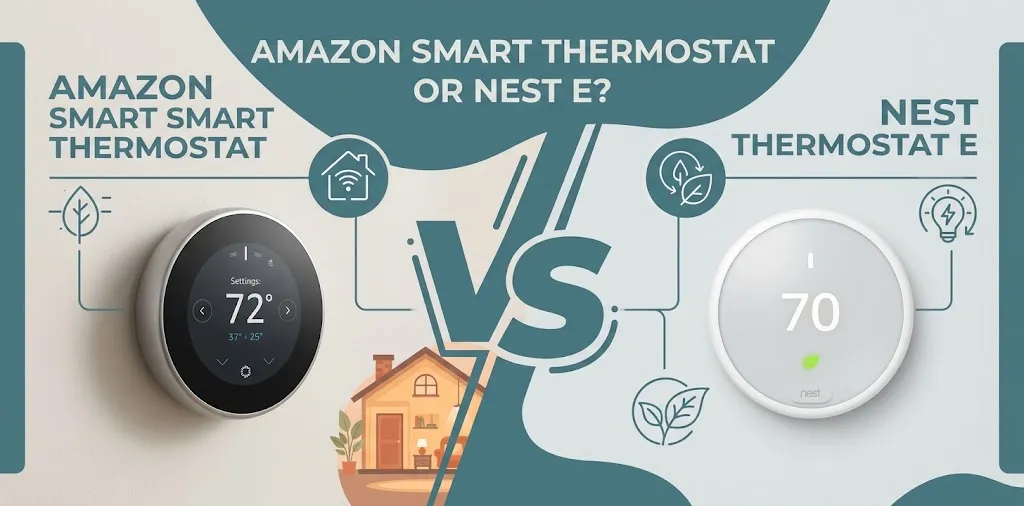
The Amazon Smart Thermostat is designed around Alexa, while the Nest Thermostat E offers learning-based scheduling and Eco features. Compatibility and available controls can vary by HVAC system and software configuration.
Which Thermostat Is Better for Saving Energy on a Budget?
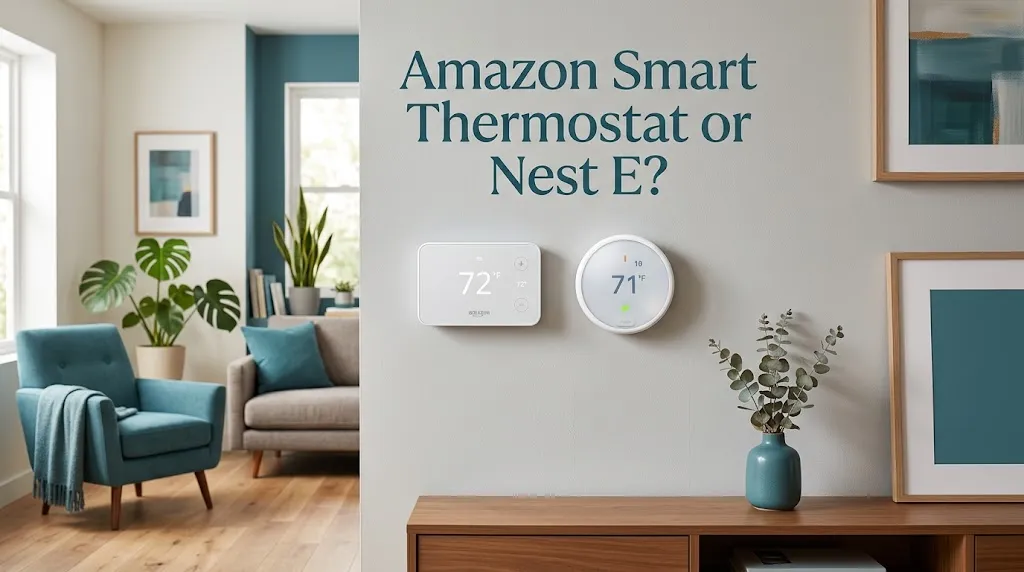
For most shoppers who want an affordable smart thermostat, the Amazon Smart Thermostat is the stronger starting point. It offers remote control, programmable schedules, and Alexa-based automation without requiring you to pay for a premium thermostat. The Nest Thermostat E can still be attractive at a good used or remaining-stock price, but its age and availability make the purchase price only part of the decision.
Why the Amazon Smart Thermostat Makes Sense for Budget Buyers
The Amazon Smart Thermostat is built for people who want useful smart features without spending much on the hardware. Its regular US list price has been around $80, although sales can lower the cost. Check the current price before buying.
Its main advantages include:
- Affordable entry price: You can add smart temperature control without paying for a more expensive learning thermostat.
- Alexa integration: Change the temperature by voice or through the Alexa app.
- Flexible scheduling: Set different temperatures for times when you’re home, asleep, or away.
- Remote access: Adjust your heating or cooling settings when you’re away from home.
- Potential energy incentives: Eligible utility programs may offer additional savings, depending on your provider and location.
Amazon also supports automatic temperature adjustments for sleep and away periods through Alexa. These features can reduce unnecessary heating or cooling when your household does not need as much comfort control.
The main drawback is that the thermostat depends heavily on the Alexa ecosystem. If your household uses Google Home or another smart home platform, check integration requirements before purchasing.
Why You Might Still Consider the Nest Thermostat E
The Google Nest Thermostat E is an older smart thermostat with useful automatic scheduling features. It can learn your temperature preferences and build a schedule around your habits, while Eco Temperatures can help reduce energy use when nobody is home.
Its strongest advantages are:
- Auto-Schedule: It can adapt its temperature schedule to your routine.
- Eco Temperatures: It can use more energy-conscious temperature settings when the home is empty.
- Nest ecosystem integration: It suits households that already use compatible Nest products and services.
- Optional temperature sensor support: It works with compatible Nest Temperature Sensors, which can help address differences in temperature between rooms.
However, the Nest Thermostat E is no longer a straightforward new retail purchase in the US. Availability may depend on installers, remaining stock, or the secondhand market. That makes its actual purchase price and the condition of the unit especially important.
If you find one at a very low price, check that it can be added to your account, that its app-based features work, and that the seller can confirm its condition before paying.
Which One Costs Less Over Time?
The Amazon Smart Thermostat will often be the more practical budget choice because its initial price is relatively low and new units are easier to find through retail channels. But the cheapest device is not automatically the cheapest installation.
Your total cost depends on the thermostat price, any wiring adapter, installation labor, and the energy savings you actually achieve.
| Cost factor | Amazon Smart Thermostat | Nest Thermostat E |
|---|---|---|
| Upfront price | Usually budget-friendly | Depends on remaining stock or resale price |
| Installation | May need a C-wire adapter | Wiring needs depend on the HVAC system |
| Professional installation | Extra cost if required | Extra cost if required |
| Energy savings | Depends on scheduling and household habits | Depends on scheduling and household habits |
| Long-term value | Strong when purchased cheaply and used with Alexa | Depends on condition, compatibility, and price |
For a fair comparison, use the total installed cost rather than just the sticker price. Neither thermostat can promise a specific reduction in your utility bill.
A Simple Example of Budget Planning
Suppose you find an Amazon Smart Thermostat for $60 on sale and a used Nest Thermostat E for $45. The Nest appears to save $15 at checkout.
But if the Nest requires extra installation work or has an uncertain return policy, that initial price difference may not represent the better deal. On the other hand, if the Nest is in excellent condition, is fully compatible, and works with your existing smart home setup, it may still be worth considering.
These are hypothetical prices, not current offers. Compare actual listings and installation needs before making your decision.
Which Thermostat Is Easier to Install?
Installation depends more on your heating and cooling system than on the thermostat’s brand.
The Amazon Smart Thermostat requires a C-wire for power, although a compatible C-wire adapter may be an option when the correct wiring is unavailable. It supports certain common 24-volt HVAC systems but is not compatible with every heat pump or dual-fuel setup.
The Nest Thermostat E supports many common heating and cooling systems, but you should still check the wiring and compatibility requirements for your specific setup before purchasing.
Before buying either device:
- Check your existing thermostat’s wiring.
- Confirm that your HVAC system is supported.
- Check whether an adapter is needed and include its cost.
- Ask a qualified HVAC professional for help if you’re unsure about the wiring.
Do not assume that a thermostat will work simply because your old thermostat has a similar shape or number of wires.
How to Get Better Energy Savings From Either Thermostat
Smart features help most when you use them to avoid heating or cooling an empty home. A thermostat that stays at the same setting all day may not take full advantage of its scheduling tools.
Here are two practical examples.
Example 1: A household that is empty during the workday
If everyone leaves home in the morning and returns in the evening, set a schedule or an appropriate away mode to reduce unnecessary heating or cooling while the house is empty. Have the temperature return to a comfortable setting around the time people come home.
Example 2: A household that is home most of the day
If someone works from home, a long away period may not make sense. Instead, use a modest schedule change during sleep or other predictable periods when less heating or cooling is needed.
For either thermostat, start with a schedule that matches your real routine. Review your utility bills over comparable periods, taking weather and energy rates into account, before deciding whether the upgrade is saving you money.
Frequently Asked Questions
Here are the answers to three common questions about choosing between these thermostats for energy savings on a budget.
Does the Amazon Smart Thermostat save more energy than the Nest Thermostat E?
Not necessarily. Both can help reduce unnecessary heating and cooling through schedules and automatic temperature adjustments. Your results depend on your HVAC system, local weather, household routine, and how you configure the thermostat.
Is the Nest Thermostat E worth buying in 2026?
It can be worth considering if you find a reasonably priced unit in good condition and confirm that it works with your HVAC system and account. Since availability is limited, check the seller’s return policy and the thermostat’s functionality before buying.
Do I need a C-wire for the Amazon Smart Thermostat?
Yes, the Amazon Smart Thermostat requires a C-wire for power or a compatible C-wire adapter. Check your existing wiring and Amazon’s compatibility guide before purchasing, and consult an HVAC professional if you’re unsure about installation.
Final Verdict
The Amazon Smart Thermostat is the better overall choice for most budget-conscious buyers who want an affordable smart thermostat with Alexa control, scheduling, and remote access. The Nest Thermostat E remains a reasonable alternative for buyers who specifically want its learning features and can find a compatible unit at a good price.